
Another Sustainable Material Choice from Bluepoint
What is Tyvek® with Renewable Attribution?
DuPontTM Tyvek® with Renewable Attribution is essentially the same Tyvek® material you're already familiar with but is attributed to more sustainable raw materials designed to reduce its carbon footprint without changing the material's performance.
Bluepoint are proud to add Tyvek® with Renewable Attribution as a premium material to its range, while still offering the standard Tyvek® that our customers know and trust, giving you more options that you can choose from.
The material comes with a reduced carbon footprint and improved circularity, whilst keeping the unique material properties that standard Tyvek® is famous for. And with the attribution of sustainable raw material ranging from 30-100%, we can now widen our range of material choices giving truly circular options.

What is Tyvek® with Renewable Attribution used for?
Bluepoint is currently trialling Tyvek® with 30% Renewable Attribution as a more sustainable wristband material choice – not as a replacement, but as a premium, sustainably-sourced alternative that sits alongside DuPont’s standard Tyvek® material. Renewable Attribution up to 100% is also available for customers wanting to move away entirely from fossil-derived materials.
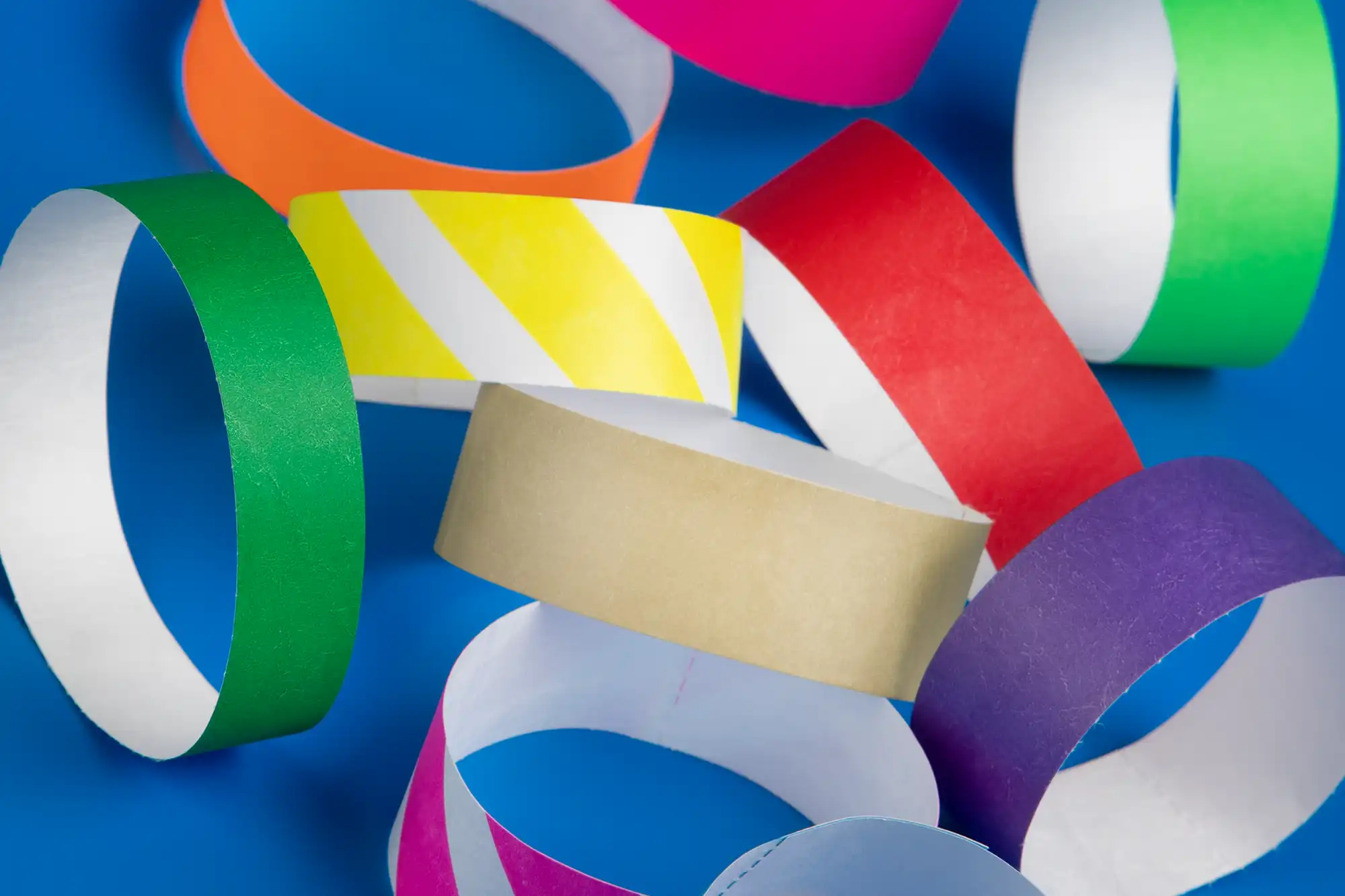
As well as wristbands, Tyvek® with Renewable Attribution is perfect for a range of tag and labelling solutions and is particularly suited to outdoor applications such as horticultural labelling and campsite tent tags.
Bluepoint can now offer Tyvek® with Renewable Attribution as a premium, more sustainable alternative to standard Tyvek®, and we’d love to hear from customers who are looking to make the switch to this truly circular material.

What actually changes?
The Tyvek® material itself remains as a high-density polyethylene (HDPE) and retains the same physical properties, strength, breathability, and printability as conventional Tyvek®. The difference is in the raw materials used to make the polyethylene.
HDPE supply chain partially replaces fossil-derived feedstocks with certified bio circular raw materials and tracks this through a mass balance system.These sustainable raw materials are bio-circular feedstocks originating from second generation biomass that does not compete with food production – for example, waste oil from restaurants, agricultural residues and food processing waste.
These renewable raw materials are attributed to the finished product through a mass balance approach, helping reduce reliance on fossil-based feedstocks while maintaining the same material performance.
What is "Renewable Attribution"?
This is where it gets interesting.
The renewable raw materials and conventional fossil feedstocks are mixed together in the chemical production process as a percentage quota. Rather than physically separating them, DuPont uses a certified accounting method called mass balance to attribute a specific quantity of renewable feedstock to certain product batches. Bluepoint can offer Tyvek® with Renewable Attribution from 30% up to 100%, as well as the trusted traditional and established Tyvek® - you now have a choice!

What are the environmental benefits?
DuPont claims that Tyvek® with Renewable Attribution can provide:
• An expected reduction of roughly one-third in the material's carbon footprint (including CO2 uptake) when switching to Tyvek® with Renewable Attribution at 30% level compared to standard Tyvek®.
• Reduced reliance on fossil resources.
• Support for customers' Scope 3 emissions reduction targets.
• A pathway towards more circular material sourcing.
DuPont report an expected reduction of roughly one-third in the material's carbon footprint (including CO2 uptake) when switching from standard Tyvek® to Tyvek® with 30% Renewable Attribution.
Why is it getting attention?
Because Tyvek® with Renewable Attribution is designed as a drop-in replacement, companies can improve sustainability metrics without redesigning packaging or requalifying entirely product portolio.
In our case, Bluepoint can offer Wristbands as well as other tag and labelling solutions using Tyvek® with Renewable Attribution. Looking and feeling exactly the same as standard Tyvek®, Tyvek® with Renewable Attribution can be printed on in the same way and worn in exactly the same manner, but with an effective 30% reduction in its carbon footprint (including CO2 uptake) at 30% renewable attribution level, compared to standard Tyvek®.
Spiked Your Interest?
If you’re looking to reduce your carbon footprint and use a more circular wristband material, without sacrificing the quality you have come to expect, ask us for a tag or wristband quote for Tyvek® with Renewable Attribution. And don’t forget, we use a repurposed glassine release liner on all our wristbands (except Litter Free) offering further carbon savings!
Speak to one of our expert team today on 01392 927 030 or get in touch at sales@bluepointtags.co.uk.


